One of the questions I regularly pose to my economics students is whether a college education is a contributor to productivity. Intriguingly, what I get in response often parallels the views of Greg Ip of the Wall Street Journal (2008, “The Declining Value Of Your College Degree”), who argues “college-educated workers are more plentiful, more commoditized and more subject to the downsizings that used to be the purview of blue-collar workers only. What employers want from workers nowadays is more narrow, more abstract and less easily learned in college.” In essence, the value of a college degree is said to be “not what it was.”
Nonetheless, a college education remains an important predictor of productivity (and earnings) in the marketplace. Even Ip concedes that “the average American with a college diploma still earns about 75% more than a worker with a high-school diploma and is less likely to be unemployed.” Given these facts, how can it be that students are so vexed by the value proposition of their education?
I have previously written about our new economy, the need for good people in our society, as well as the importance of polyvalence in the workplace. I argue here that there exists today a crying need for people with versatile skills sets in what is a transforming global economy and that the university offers the best opportunity to acquire the knowledge required to succeed in this environment.
This leads to the next contention I often hear from students, that “experience counts more than education?” My response to this view is, “not really,” because what is paramount is neither experience nor education, but skills, and if one is complacent in acquiring new skills experientially, embedded knowledge eventually becomes obsolete. The good news is that experience often translates into new more refined skills. The bad news is that breadth and depth of knowledge are not assured through experiential learning. Hence, attention is required to ensure one’s career track includes a multiplicity of experiences in organization and management across a diversity of functions, and eventually industries. In my view, the university offers the most efficient place to acquire breadth and depth of knowledge, as opposed to the workplace, where resources and opportunities for the same are typically limited. Experience that does not result in additional skills has little value in the workplace.
Finally, there is the matter of college graduates who are anomalously incompetent. This happens, and when it does, these people are released for cause. Those who finish a college degree program while somehow avoiding skill acquisition, do so at their peril. Acquiring new skills is the responsibility of all workers who wish to enhance or expand their careers, but especially college graduates. To attend a college or university and not acquire new knowledge along the way is a bewildering and perplexing outcome that defies good judgment.
Concluding, a college education is the most reliable track to improving skills, productivity, and earnings. And while experience can certainly result in new skills, the typical worker will find acquiring the breadth and depth of knowledge necessary to enhance or expand a career through experience alone, challenging. A college degree is still the most profound symbol of embedded knowledge available in our society today.
Showing posts sorted by relevance for query knowledge. Sort by date Show all posts
Showing posts sorted by relevance for query knowledge. Sort by date Show all posts
Tuesday, July 22, 2008
Sunday, April 03, 2011
The Way of Ignorance
Society's knowledge of the world and universe continues to advance exponentially. Nevertheless, we the people are at greater risk today than perhaps at any other time in our existence. The reason that society is at such risk is our inability, or perhaps our unwillingness, to harness new knowledge exclusively for the betterment of humanity. The following quote by Wendell Berry sums up society's knowledge problems perfectly:

Source: Berry, W (2005), The Way of Ignorance and Other Essays, Berkeley, CA: Counterpoint.
Ignorance, arrogance, narrowness of mind, incomplete konwledge, and counterfeit knowledge are of concern to us because they are dangerous, they cause destruction. When united with great power, they cause great destruction. They have caused far too much destruction already, too often of irreplaceable things. Now, reasonably enough, we are asking if it is possible, if it is even thinkable, that the destruction can be stopped. To some people's surprise, we are again backed up against the fact that knowledge is not in any simple way good. We have often been a destructive species, we are more destructive now than we have ever been, and this, in perfect accordance with ancient warnings, is because of our ignorant and arrogant use of knowledge. (Berry, 2005, p. 59)I sometimes wonder about just how far astray our society's ignorant ways might lead us...
Source: Berry, W (2005), The Way of Ignorance and Other Essays, Berkeley, CA: Counterpoint.
Wednesday, March 31, 2010
Polyvalence Defies Commoditization
One of the tacit objectives of commoditization is to disembed knowledge from humans in order to reembody that knowledge into technology (Giddens, 1990). The impact of commoditization on knowledge workers is a well-understood facet of post-modernization and the new economy.
The success of the commoditization movement has been particularly discouraging for professional services as the public sector is increasingly unwilling to pay premium fees for services, and the private sector is too distrustful of professionals to engage them even when doing so is arguably prudent. Joan Capelin's (2005) expressed sentiments are commonplace:
Polyvalence denotes something that has multiple values, meanings, or appeals. Polyvalence (which is a synonym for multivalence) is a state or the way something is with respect to its main attributes, as in “the current state of knowledge,” “the state of one’s health,” and “the state of the economy.” Polyvalent symbols and metaphors carry multiple (often esoteric) meanings and can fulfill expressive, transactional, and interactional functions concurrently.
 Prof Daniel Bell (2003) first used the term polyvalent to describe human activities that are difficult or impossible to delegate, let alone commoditize. Examples of polyvalent human functions include surgery, piloting an aircraft, coaching a professional sports team, and representing a client in court. Thus, the professions are often associated with polyvalence.
If technology can displace a particular human activity, then the displaced activity is no longer truly polyvalent.
More to follow about polyvalence in future posts.
Sources:
Capelin, J (2005, September 8), Confronting Commoditization, DesignIntelligence.
Cohen, D (2003), Our Modern Times: The New Nature of Companies in the Information Age (S Clay and D Cohen, Trans), Cambridge, MA: MIT Press.
Giddens, A (1990), The Consequences of Modernity, Stanford, CA: Stanford University Press.
Related Posts:
Financial Management Requires Polyvalence
The Topological Landscape between Automation and Expertise
The success of the commoditization movement has been particularly discouraging for professional services as the public sector is increasingly unwilling to pay premium fees for services, and the private sector is too distrustful of professionals to engage them even when doing so is arguably prudent. Joan Capelin's (2005) expressed sentiments are commonplace:
It is cold comfort to realize that all the professions are experiencing this race to the bottom. We tend not to see the effects of commoditization — nor even feel sympathetic — when lawyers, accountants, and management consultants find they are being squeezed for lower fees by their marketplace. They are far more rewarded for their time, to begin with. But I can tell you that there is much handwringing going on across all the business-based professions.Nevertheless, as the forces of commoditization continue their forays into the realm of human knowledge in search of latent technologies, critical issues are emerging about how and if certain human specific functions can feasibly be transferred into machines. In particular, the expert handling of polyvalent information and data seems to defy commoditization.
Polyvalence denotes something that has multiple values, meanings, or appeals. Polyvalence (which is a synonym for multivalence) is a state or the way something is with respect to its main attributes, as in “the current state of knowledge,” “the state of one’s health,” and “the state of the economy.” Polyvalent symbols and metaphors carry multiple (often esoteric) meanings and can fulfill expressive, transactional, and interactional functions concurrently.

If technology can displace a particular human activity, then the displaced activity is no longer truly polyvalent.
More to follow about polyvalence in future posts.
Sources:
Capelin, J (2005, September 8), Confronting Commoditization, DesignIntelligence.
Cohen, D (2003), Our Modern Times: The New Nature of Companies in the Information Age (S Clay and D Cohen, Trans), Cambridge, MA: MIT Press.
Giddens, A (1990), The Consequences of Modernity, Stanford, CA: Stanford University Press.
Related Posts:
Financial Management Requires Polyvalence
The Topological Landscape between Automation and Expertise
Friday, March 05, 2010
Continuum of Pure Uncertainty and Certainty
Prof Hossein Arsham makes an excellent case for using probabilistic (i.e., stochastic) models when confronted with "risky" decisions. His continuum of pure uncertainty and certainty is instructive for analysts and decision makers alike:
Source: Tools for Decision Analysis
The domain of decision analysis models falls between two extreme cases. This depends upon the degree of knowledge we have about the outcome of our actions, as shown below:The truth is that few financial decisions are made in an environment of complete knowledge, begging the question as to why deterministic models continue to prevail upon management. I maintain that the future of financial economics is probabilistic.
Ignorance Risky Situation Knowledge<-------------------------|------------------------->Uncertainty Probabilistic Deterministic
One "pole" on this scale is deterministic... The opposite "pole" is pure uncertainty. Between these two extremes are problems under risk. The main idea here is that for any given problem, the degree of certainty varies among managers depending upon how much knowledge each one has about the same problem. This reflects the recommendation of a different solution by each person.
Source: Tools for Decision Analysis
Sunday, June 06, 2010
The Evolution of Decision Analysis
by Ronald A Howard © The Stanford Decisions and Ethics Center
Although decision analysis has developed significantly over the last two decades, the basic principles of the field have served well. They are unlikely to change because they are based on simple logic. In the first part of this paper, we summarize the original, fundamental disciplines of decision analysis; in the second part, we show how the discipline has evolved.
PART I: A BRIEF DESCRIPTION OF DECISION ANALYSIS
Making important decisions often requires treating major uncertainty, long time horizons, and complex value issues. To deal with such problems, the discipline of decision analysis was developed. The discipline comprises the philosophy, theory, methodology, and professional practice necessary to formalize the analysis of important decisions.
Overview of Decision Analysis
Decision analysis is the latest step in a sequence of quantitative advances in the operations research/management science field. Specifically, decision analysis results from combining the fields of systems analysis and statistical decision theory. Systems analysis, which grew as a branch of engineering, was good at capturing the interactions and dynamic behavior of complex situations. Statistical decision theory was concerned with logical decisions in simple, uncertain situations. The merger of these concepts creates a methodology for making logical decisions in complex, dynamic, and uncertain situations.
Decision analysis specifies the alternatives, information, and preferences of the decision-maker and then finds the logically implied decision.
Decision-making requires choosing between alternatives, mutually exclusive resource allocations that will produce outcomes of different desirabilities with different likelihoods. While the range of alternatives to be considered is set by the decision-maker, the decision analyst may be able to suggest new alternatives as the analysis progresses.
Since uncertainty is at the heart of most significant decision problems, decision-making requires specifying the amount of uncertainty that exists given available information. Many decision problems become relatively trivial if uncertainty is removed. For example, consider how easily a decision-maker could make a critical decision in launching a new commercial product if he could predict with certainty production and sales costs, price-demand relationships, and governmental decisions. Decision analysis treats uncertainty effectively by encoding informed judgment in the form of probability assignments to events and variables.
Decision-making also requires assigning values on the outcomes of interest to the decision-maker. These outcomes may be as customary as profit or as troubling as pain. Decision analysis determines the decision-maker's trade-offs between monetary and non-monetary outcomes and also establishes in quantitative terms his preferences for outcomes that are risky or distributed over time.
One of the most basic concepts in decision analysis is the distinction between a good decision and a good outcome. A good decision is a logical decision -- one based on the information, values, and preferences of the decision-maker. A good outcome is one that is profitable, or otherwise highly valued. In short, a good outcome is one that we wish would happen. By making good decisions in all situations that face us, we hope to ensure as high a percentage of good outcomes as possible. We may be disappointed to find that a good decision has produced a bad outcome, or dismayed to learn that someone who has made what we consider to be a bad decision has achieved a good outcome. Short of having a clairvoyant, however, making good decisions is the best way to pursue good outcomes.
An important benefit of decision analysis is that it provides a formal, unequivocal language for communication among the people included in the decision-making process. During the analysis, the basis for a decision becomes evident, not just the decision itself. A disagreement about whether to adopt an alternative may occur because individuals possess different relevant information or because they place different values on the consequences. The formal logic of decision analysis subjects these component elements of the decision process to scrutiny. Information gaps can be uncovered and filled, and differences in values can be openly examined. Revealing the sources of disagreement usually opens the door to cooperative resolution.
The formalism of decision analysis is also valuable for vertical communication in a management hierarchy. The organizational value structure determined by policymakers must be wedded to the detailed information that the line manager, staff analyst, or research worker possesses. By providing a structure for delegating decision-making to lower levels of authority and for synthesizing information from diverse areas for decision-making at high levels, decision analysis accomplishes this union.
Methodology
The application of decision analysis often takes the form of an iterative procedure called the Decision Analysis Cycle (see Figure 1). Although this procedure is not an inviolable method of attacking the problem, it is a means of ensuring that essential steps have been considered.

The procedure is divided into three phases. In the first (deterministic) phase, the variables affecting the decision are defined and related, values are assigned, and the importance of the variables is measured without any consideration of uncertainty.
The second (probabilistic) phase starts with the encoding of probability on the important variables; then, the associated probability assignments on values are derived. This phase also introduces the assessment of risk preference, which defines the best solution in the face of uncertainty.
In the third (informational) phase, the results of the first two phases are reviewed to determine the economic value of eliminating uncertainty in each of the important variables in the problem. In some ways, this is the most important phase because it shows just what it would be worth in dollars and cents to have perfect information. Comparing the value of information with its cost determines whether additional information should be collected.
If there are further profitable sources of information, then the decision should be to gather the information rather than to make the primary decision at this time. The design and execution of the information-gathering program follows.
Since new information generally requires revisions in the original analysis, the original three phases must be performed once more. However, the additional work required to incorporate the modifications is usually slight, and the evaluation, rapid. At the decision point, it may again be profitable to gather new information and repeat the cycle, or it may be more advisable to act. Eventually, the decision to act will be made because the value of new analysis and information-gathering will be less than its cost.
Applying the above procedure ensures that the total effort is responsive to changes in information -- the approach is adaptive. Identifying the crucial areas of uncertainty can also aid in generating new alternatives for future analysis.
Model Sequence
Typically, a decision analysis is performed not with one, but with a sequence of progressively more realistic models. These models generally will be in the form of computer programs. The first model in the sequence is the pilot model, an extremely simplified representation of the problem useful only for determining the most important relationships. Although the pilot model looks very little like the desired final product, it is indispensable in achieving that goal.
The next model in the sequence is the prototype model, a quite detailed representation of the problem that may, however, still be lacking a few important attributes. Although it will generally have objectionable features that must be eliminated, it does demonstrate how the final version will appear and perform.
The final model in the sequence is the production model; it is the most accurate representation of reality that decision analysis can produce. It should function well even though it may retain features that are treated in a less than ideal way.
Starting with the pilot model, sensitivity analyses are used throughout each phase to guide its further evolution. If decisions are insensitive to changes in some aspect of the model, there is no need to model that particular aspect in more detail. The goal of a good modeler is to model in detail only those aspects of the problem that have an impact on the decisions, while keeping the costs of this modeling commensurate with the level of the overall analysis.
Important aids in determining whether further modeling is economically justifiable are the calculations of the value of information. Some variables may be uncertain partially because detailed models have not bee" constructed. If the analyst can calculate the value of perfect information about these variables, he will have a standard to use in comparing the co of any additional modeling. If the cost of modeling is greater than the value of perfect information, the modeling is clearly not economically justifiable.
Using a combination of sensitivity analysis and calculations of the value of information, the analyst continually directs the development of model in an economically efficient way. An analysis conducted in this wa provides not only answers, but also often insights for creating new alternatives. When completed, the model should be able to withstand the test of any good engineering design: additional modeling resources could utilized with equal effectiveness in any part of the model. There is no such thing as a final or complete analysis; there is only an economic analysis given the resources available.
PART II: REFINEMENTS AND NEW DEVELOPMENTS IN DECISION ANALYSIS
Having seen the basic concepts of decision analysis and the main poi of its professional practice, let us now examine some of the evolution changes in the field over the last two decades.
The Decision Basis
It has become useful to have a name for the formal description of a decision problem; we call it the decision basis. The decision basis consists of a quantitative specification of the three elements of the basis: the alternatives, the information, and the preferences of the decision-maker. We can then think of two essential steps in any decision analysis: the development and the evaluation of the decision basis.
Basis Development
To develop the decision basis, the decision analyst must elicit each of the three elements from the decision-maker or from his delegates. For example, in a medical problem, the ultimate decision-maker should be the patient. The patient would provide the element of preference in the basis, probably in a series of interviews with the decision analyst. In most cases, however, the patient will delegate the alternative and information elements to doctors who, in turn, would be interviewed by the decision analyst. The analyst should be able to certify that the decision basis accurately represents the alternatives, information, and preferences provided directly or indirectly by the decision-maker. We should note here that the alternatives must include alternatives of information-gathering, such as tests, experimental programs, surveys, or pilot plants.
One key issue is the extent to which the decision analyst can provide substantive portions of the decision basis by acting as an expert. In many circumstances, the analyst cannot be an expert because he has only a lay knowledge of the decision field. Even when the analyst does have substantial knowledge of the subject area, he should make clear to the decision-maker when he has changed from the role of decision analyst to that substantive expert. Playing the role of expert can also force the analyst to defend his views against those of others; to this extent, he would be less of a "fair witness" in the subsequent analysis. Nevertheless, this possible loss of impartiality and fresh viewpoint must be balanced against the communication advantages of dealing with an analyst familiar with the decision field.
Basis Evaluation
Once the basis is developed, the next step is to evaluate it using the sensitivity analysis and value of information calculations described earlier. However, casting the problem as a decision basis shows that value-of-information calculations, important as they are, focus on only one element of the basis -- information.
Using the concept of the basis, we can also compute the value of a new alternative, which we might call the value of control. Such a calculation might well motivate the search for an alternative with certain characteristics and perhaps even the development of such an alternative.
One can perform a similar sensitivity analysis to preference with the intention not of changing preference, but of ensuring that preferences have been accurately assessed. A large change in value resulting from a small change in preference would indicate the need for more interviews about preference.
A Revised Cycle
Using the concept of the basis, we may wish to restructure the decision analysis cycle in the four-phase form shown in Figure 2. Here, the information gathering that must precede analysis or augment subsequent analyses has been included in a basis development phase. The deterministic and probabilistic phases are essentially unchanged, but the informational phase -- renamed "basis appraisal" -- is expanded to include the examination of all three basis elements.

A Refined Analysis Sequence
As a problem is analyzed, the analysis may progress through the decision analysis cycle several times in increasing levels of detail. The basic distinction is between the pilot and full-scale analysis. The pilot analysis is a simplified, approximate, but comprehensive, analysis of a decision problem. The dictionary defines pilot as "serving as a tentative model for future experiment or development." The full-scale analysis is an increasingly realistic, accurate, and justifiable analysis of a decisicision problem, where full-scale is defined as "employing all resources, not limited or partial." To understand these distinctions, we must explain in more detail what constitutes a pilot or full-scale analysis.
The purpose of a pilot analysis is to provide understanding and establish effective communication about the nature of the decision and the major issues surrounding it. The content of the pilot analysis is a simplified decision model, a tentative preference structure, and a rough characterization of uncertainty. From a pilot analysis, the decision-maker should expect preliminary recommendations for the decision and the analyst should expect guidance in conducting the full-scale analysis.
The purpose of the full-scale analysis is to find the most desirable action, given the fully developed decision basis. The full-scale analysis consists of a balanced and realistic decision model, preferences that have been certified by the decision-maker, and a careful representation of important uncertainties. From the full-scale analysis, the decision-maker should expect a recommended course of action.
While most analyses progress from pilot to full-scale, some are so complex that valuable distinctions may be made between different stages of full-scale analysis.
The first stage of full-scale analysis is the prototypical stage, which is intended to reveal weaknesses and excesses in the full-scale analysis that are worthy of correction. A prototype is defined as "an original type, form, or instance that serves as a model on which later stages are based or judged."
After the indicated corrections have been made, the analyst has an integrated stage of full-scale analysis that provides the decision-maker with confidence in having a unified, balanced, and economic analysis as a basis for decision. To integrate is "to make into a whole by bringing all parts together: unify." If a decision-maker is making a personal decision that will not require the support or approval of others, then the integrated stage of full-scale analysis is all that is required. However, if the decision-maker must convince others of the wisdom of the chosen course of action or even defend that course against hostile elements, then an additional stage of full-scale analysis will be necessary — the defensible stage.
The defensible stage of full-scale analysis is intended to demonstrate to supportive, doubtful, and possibly hostile audiences that the analysis provides an appropriate basis for decision. Defensible means "capable of being defended, protected, or justified." Typically, defensible analyses are necessary for important decisions in the public arena; however, even private enterprises may wish to conduct defensible analyses to win the support of workers, financial institutions, or venture partners. Defensible analyses are very demanding because they must show not only that the basis used is reasonable, but also that other possible bases that would lead to different decisions are not reasonable.
Contributions from Psychological Research
One of the most significant factors influencing the practice of decision analysis in recent years has been new knowledge about cognitive processes from the field of psychology. This research, centering on the contribution of Kahneman and Tversky, has had two major effects. First, the research on cognitive biases [10] has shown the need for subtlety and careful procedure in eliciting the probabilistic judgments on which decision analysis depends. Second, and perhaps even more important the descriptive research on how people actually make decisions [6,11] shows that man is considerably less skilled in decision-making than expected. The main thrust of this research shows that people violate the rules of probabilistic logic in even quite simple settings. When we say that people violate certain rules, we mean that when they are made aware of the implications of their choices, they often wish they had made another choice: that is, they realize they have made a mistake. While these mistakes can be produced in analyzing simple decision settings, they become almost unavoidable when the problem is complex.
These findings may change our interpretation of the logical axioms that are the foundations of decision analysis. We have always considered these axioms as normative: they must be satisfied if our decisions are to have many properties that we would regard as desirable. If a particular individual did not satisfy the axioms, then he would be simply making mistakes in the view of those who followed the axioms. While this interpretation is still possible, a more appropriate way to look at the axioms is that they describe what any person would do if faced with a situation as simple as the one described by the axioms. In other words, the axioms are descriptive of human behavior for simple situations. If, however, the situation becomes more complex, more "opaque" as opposed to "transparent," the axioms are no longer descriptive because the person may unintentionally violate the axiom systems.
We may now think of the job of the decision analyst as that of making "opaque" situations "transparent," so that the person clearly sees what t do. This interpretation of the work may not make it any easier, but it is far more humane than the view that the analyst is trying to impose logic willfully illogical world.
Influence Diagrams
The influence diagram is one of the most useful concepts developed in decision analysis [3]. The analyst has always faced the problem of how to reduce the multifaceted knowledge in people's heads to a form that could meet the rigid tests of explicitness and consistency required by a computer. The analyst has always faced the problem of how to reduce the multifaceted knowledge in people's heads to a form that could meet the rigid tests of explicitness and consistency required by a computer. The influence diagram is a major aid in this transformation because it cross the border between the graphic view of relationships that is very convenient for human beings and the explicit equations and numbers that are the province of present computers. To find a device that can readily be sketched by a layman and yet be so carefully defined that useful theorems concerning it can be proved by formal methods is rare. Although there is a danger that people who do not thoroughly understand influence diagrams may abuse them and be misled, there is an even greater promise that the influence diagram will be an important bridge between analyst and decision-maker.
Valuing Extreme Outcomes
One of the problems perplexing early users of decision analysis was how to treat outcomes so extreme that they seemed to be beyond analysis. For example, the question of how a person's death as the result of medical treatment can be balanced with other medical outcomes, like paralysis or even purely economic outcomes, was especially demanding. These problems appear to raise both ethical dilemmas and technical difficulties. One ethical dilemma centered on who had the right to value lives. A technical difficulty was revealed when an economist testifying in court on the value of a life was asked whether he would be willing to allow himself to be killed if he were given that amount of money. Nevertheless, once the ethical issue is clarified by acknowledging that a person may properly place a value on his own life, then the technical question of how to do it can be addressed quite satisfactorily, especially in the case of exposure to the many small risks present in modern life [4,5]. The results have major implications for many decisions affecting health and safety.
The development of ways to think about the unthinkable has shown that no decision problem lies beyond the realm of decision analysis. That is very satisfying, for were you faced with medical decisions about a loved one, would you want to use second-rate logic any more than a second-rate doctor?
Conclusion
When decision analysis was first developed, a common comment was, "If this is such a great idea, why doesn't [insert name of large, famous company] use it?" Today, it is difficult to find a major corporation that has not employed decision analysis in some form. There are some factors that should lead to even greater use. For example, decision analysis procedures are now more efficiently executable because the increased power of modern computers has reduced the costs of even very complex analyses to an affordable level. The problems that can be successfully attacked now run the gamut of all important decision problems. Increasing uncertainties and rapid change require fresh solutions rather than tested "rules of thumb." Some day, decision analysis of important decisions will perhaps become recognized as so necessary for conducting a provident life that it will be taught in grade school rather than in graduate school.
References:
1. Ronald A Howard, "Decision Analysis: Applied Decision Theory," Proceedings of the Fourth International Conference on Operational Research, Wiley-Interscience, New York, 1966, pp. 55-71.
2. Ronald A Howard, "The Foundations of Decision Analysis," IEEE Transactions on Systems Science and Cybernetics, SSC-4, No. 3, (September 1968): 211-19.
3. Ronald A Howard and James E Matheson, "Influence Diagrams," Department of Engineering-Economic Systems, Stanford University, July 1979.
4. Ronald A Howard, "On Making Life and Death Decisions," Societal Risk Assessment, How Safe Is Safe Enough?, Edited by Richard C. Schwing and Walter A Albers, Jr, General Motors Research Laboratories, Plenum Press, New York, 1980.
5. Ronald A Howard, James E Matheson, and Daniel L Owen, "The Value of Life and Nuclear Design," Proceedings of the American Nuclear Society Topical Meeting on Probabilistic Analysis of Nuclear Reactor Safety, American Nuclear Society, May 8-10, 1978.
6. Daniel Kahneman and Amos Tversky, "Prospect Theory: An Analysis of Decision under Risk," Econometrica, 47, No. 2 (March 1979): 263-291.
7. D Warner North, "A Tutorial Introduction to Decision Theory," IEEE Transactions on Systems Science and Cybernetics, SSC-4, No 3, (September 1968): 200-10.
8. Howard Raiffa, Decision Analysis: Introductory Lectures on Choices under Uncertainty, Addison-Wesley, 1968.
9. Myron Tribus, Rational Descriptions, Decisions, and Designs, Pergamon Press, 1969.
10. Amos Tversky and Daniel Kahneman, "Judgment under Uncertainty: Heuristics and Biases," Science, 185 (Sept 27, 1974): 1124-1131.
11. Amos Tversky and Daniel Kahneman, "The Framing of Decisions and the Psychology of Choice," Science, 211 (Jan 30, 1981): 453-458.
Republished with permission of The Stanford Decisions and Ethics Center
Although decision analysis has developed significantly over the last two decades, the basic principles of the field have served well. They are unlikely to change because they are based on simple logic. In the first part of this paper, we summarize the original, fundamental disciplines of decision analysis; in the second part, we show how the discipline has evolved.
PART I: A BRIEF DESCRIPTION OF DECISION ANALYSIS
Making important decisions often requires treating major uncertainty, long time horizons, and complex value issues. To deal with such problems, the discipline of decision analysis was developed. The discipline comprises the philosophy, theory, methodology, and professional practice necessary to formalize the analysis of important decisions.
Overview of Decision Analysis
Decision analysis is the latest step in a sequence of quantitative advances in the operations research/management science field. Specifically, decision analysis results from combining the fields of systems analysis and statistical decision theory. Systems analysis, which grew as a branch of engineering, was good at capturing the interactions and dynamic behavior of complex situations. Statistical decision theory was concerned with logical decisions in simple, uncertain situations. The merger of these concepts creates a methodology for making logical decisions in complex, dynamic, and uncertain situations.
Decision analysis specifies the alternatives, information, and preferences of the decision-maker and then finds the logically implied decision.
Decision-making requires choosing between alternatives, mutually exclusive resource allocations that will produce outcomes of different desirabilities with different likelihoods. While the range of alternatives to be considered is set by the decision-maker, the decision analyst may be able to suggest new alternatives as the analysis progresses.
Since uncertainty is at the heart of most significant decision problems, decision-making requires specifying the amount of uncertainty that exists given available information. Many decision problems become relatively trivial if uncertainty is removed. For example, consider how easily a decision-maker could make a critical decision in launching a new commercial product if he could predict with certainty production and sales costs, price-demand relationships, and governmental decisions. Decision analysis treats uncertainty effectively by encoding informed judgment in the form of probability assignments to events and variables.
Decision-making also requires assigning values on the outcomes of interest to the decision-maker. These outcomes may be as customary as profit or as troubling as pain. Decision analysis determines the decision-maker's trade-offs between monetary and non-monetary outcomes and also establishes in quantitative terms his preferences for outcomes that are risky or distributed over time.
One of the most basic concepts in decision analysis is the distinction between a good decision and a good outcome. A good decision is a logical decision -- one based on the information, values, and preferences of the decision-maker. A good outcome is one that is profitable, or otherwise highly valued. In short, a good outcome is one that we wish would happen. By making good decisions in all situations that face us, we hope to ensure as high a percentage of good outcomes as possible. We may be disappointed to find that a good decision has produced a bad outcome, or dismayed to learn that someone who has made what we consider to be a bad decision has achieved a good outcome. Short of having a clairvoyant, however, making good decisions is the best way to pursue good outcomes.
An important benefit of decision analysis is that it provides a formal, unequivocal language for communication among the people included in the decision-making process. During the analysis, the basis for a decision becomes evident, not just the decision itself. A disagreement about whether to adopt an alternative may occur because individuals possess different relevant information or because they place different values on the consequences. The formal logic of decision analysis subjects these component elements of the decision process to scrutiny. Information gaps can be uncovered and filled, and differences in values can be openly examined. Revealing the sources of disagreement usually opens the door to cooperative resolution.
The formalism of decision analysis is also valuable for vertical communication in a management hierarchy. The organizational value structure determined by policymakers must be wedded to the detailed information that the line manager, staff analyst, or research worker possesses. By providing a structure for delegating decision-making to lower levels of authority and for synthesizing information from diverse areas for decision-making at high levels, decision analysis accomplishes this union.
Methodology
The application of decision analysis often takes the form of an iterative procedure called the Decision Analysis Cycle (see Figure 1). Although this procedure is not an inviolable method of attacking the problem, it is a means of ensuring that essential steps have been considered.

The procedure is divided into three phases. In the first (deterministic) phase, the variables affecting the decision are defined and related, values are assigned, and the importance of the variables is measured without any consideration of uncertainty.
The second (probabilistic) phase starts with the encoding of probability on the important variables; then, the associated probability assignments on values are derived. This phase also introduces the assessment of risk preference, which defines the best solution in the face of uncertainty.
In the third (informational) phase, the results of the first two phases are reviewed to determine the economic value of eliminating uncertainty in each of the important variables in the problem. In some ways, this is the most important phase because it shows just what it would be worth in dollars and cents to have perfect information. Comparing the value of information with its cost determines whether additional information should be collected.
If there are further profitable sources of information, then the decision should be to gather the information rather than to make the primary decision at this time. The design and execution of the information-gathering program follows.
Since new information generally requires revisions in the original analysis, the original three phases must be performed once more. However, the additional work required to incorporate the modifications is usually slight, and the evaluation, rapid. At the decision point, it may again be profitable to gather new information and repeat the cycle, or it may be more advisable to act. Eventually, the decision to act will be made because the value of new analysis and information-gathering will be less than its cost.
Applying the above procedure ensures that the total effort is responsive to changes in information -- the approach is adaptive. Identifying the crucial areas of uncertainty can also aid in generating new alternatives for future analysis.
Model Sequence
Typically, a decision analysis is performed not with one, but with a sequence of progressively more realistic models. These models generally will be in the form of computer programs. The first model in the sequence is the pilot model, an extremely simplified representation of the problem useful only for determining the most important relationships. Although the pilot model looks very little like the desired final product, it is indispensable in achieving that goal.
The next model in the sequence is the prototype model, a quite detailed representation of the problem that may, however, still be lacking a few important attributes. Although it will generally have objectionable features that must be eliminated, it does demonstrate how the final version will appear and perform.
The final model in the sequence is the production model; it is the most accurate representation of reality that decision analysis can produce. It should function well even though it may retain features that are treated in a less than ideal way.
Starting with the pilot model, sensitivity analyses are used throughout each phase to guide its further evolution. If decisions are insensitive to changes in some aspect of the model, there is no need to model that particular aspect in more detail. The goal of a good modeler is to model in detail only those aspects of the problem that have an impact on the decisions, while keeping the costs of this modeling commensurate with the level of the overall analysis.
Important aids in determining whether further modeling is economically justifiable are the calculations of the value of information. Some variables may be uncertain partially because detailed models have not bee" constructed. If the analyst can calculate the value of perfect information about these variables, he will have a standard to use in comparing the co of any additional modeling. If the cost of modeling is greater than the value of perfect information, the modeling is clearly not economically justifiable.
Using a combination of sensitivity analysis and calculations of the value of information, the analyst continually directs the development of model in an economically efficient way. An analysis conducted in this wa provides not only answers, but also often insights for creating new alternatives. When completed, the model should be able to withstand the test of any good engineering design: additional modeling resources could utilized with equal effectiveness in any part of the model. There is no such thing as a final or complete analysis; there is only an economic analysis given the resources available.
PART II: REFINEMENTS AND NEW DEVELOPMENTS IN DECISION ANALYSIS
Having seen the basic concepts of decision analysis and the main poi of its professional practice, let us now examine some of the evolution changes in the field over the last two decades.
The Decision Basis
It has become useful to have a name for the formal description of a decision problem; we call it the decision basis. The decision basis consists of a quantitative specification of the three elements of the basis: the alternatives, the information, and the preferences of the decision-maker. We can then think of two essential steps in any decision analysis: the development and the evaluation of the decision basis.
Basis Development
To develop the decision basis, the decision analyst must elicit each of the three elements from the decision-maker or from his delegates. For example, in a medical problem, the ultimate decision-maker should be the patient. The patient would provide the element of preference in the basis, probably in a series of interviews with the decision analyst. In most cases, however, the patient will delegate the alternative and information elements to doctors who, in turn, would be interviewed by the decision analyst. The analyst should be able to certify that the decision basis accurately represents the alternatives, information, and preferences provided directly or indirectly by the decision-maker. We should note here that the alternatives must include alternatives of information-gathering, such as tests, experimental programs, surveys, or pilot plants.
One key issue is the extent to which the decision analyst can provide substantive portions of the decision basis by acting as an expert. In many circumstances, the analyst cannot be an expert because he has only a lay knowledge of the decision field. Even when the analyst does have substantial knowledge of the subject area, he should make clear to the decision-maker when he has changed from the role of decision analyst to that substantive expert. Playing the role of expert can also force the analyst to defend his views against those of others; to this extent, he would be less of a "fair witness" in the subsequent analysis. Nevertheless, this possible loss of impartiality and fresh viewpoint must be balanced against the communication advantages of dealing with an analyst familiar with the decision field.
Basis Evaluation
Once the basis is developed, the next step is to evaluate it using the sensitivity analysis and value of information calculations described earlier. However, casting the problem as a decision basis shows that value-of-information calculations, important as they are, focus on only one element of the basis -- information.
Using the concept of the basis, we can also compute the value of a new alternative, which we might call the value of control. Such a calculation might well motivate the search for an alternative with certain characteristics and perhaps even the development of such an alternative.
One can perform a similar sensitivity analysis to preference with the intention not of changing preference, but of ensuring that preferences have been accurately assessed. A large change in value resulting from a small change in preference would indicate the need for more interviews about preference.
A Revised Cycle
Using the concept of the basis, we may wish to restructure the decision analysis cycle in the four-phase form shown in Figure 2. Here, the information gathering that must precede analysis or augment subsequent analyses has been included in a basis development phase. The deterministic and probabilistic phases are essentially unchanged, but the informational phase -- renamed "basis appraisal" -- is expanded to include the examination of all three basis elements.

A Refined Analysis Sequence
As a problem is analyzed, the analysis may progress through the decision analysis cycle several times in increasing levels of detail. The basic distinction is between the pilot and full-scale analysis. The pilot analysis is a simplified, approximate, but comprehensive, analysis of a decision problem. The dictionary defines pilot as "serving as a tentative model for future experiment or development." The full-scale analysis is an increasingly realistic, accurate, and justifiable analysis of a decisicision problem, where full-scale is defined as "employing all resources, not limited or partial." To understand these distinctions, we must explain in more detail what constitutes a pilot or full-scale analysis.
The purpose of a pilot analysis is to provide understanding and establish effective communication about the nature of the decision and the major issues surrounding it. The content of the pilot analysis is a simplified decision model, a tentative preference structure, and a rough characterization of uncertainty. From a pilot analysis, the decision-maker should expect preliminary recommendations for the decision and the analyst should expect guidance in conducting the full-scale analysis.
The purpose of the full-scale analysis is to find the most desirable action, given the fully developed decision basis. The full-scale analysis consists of a balanced and realistic decision model, preferences that have been certified by the decision-maker, and a careful representation of important uncertainties. From the full-scale analysis, the decision-maker should expect a recommended course of action.
While most analyses progress from pilot to full-scale, some are so complex that valuable distinctions may be made between different stages of full-scale analysis.
The first stage of full-scale analysis is the prototypical stage, which is intended to reveal weaknesses and excesses in the full-scale analysis that are worthy of correction. A prototype is defined as "an original type, form, or instance that serves as a model on which later stages are based or judged."
After the indicated corrections have been made, the analyst has an integrated stage of full-scale analysis that provides the decision-maker with confidence in having a unified, balanced, and economic analysis as a basis for decision. To integrate is "to make into a whole by bringing all parts together: unify." If a decision-maker is making a personal decision that will not require the support or approval of others, then the integrated stage of full-scale analysis is all that is required. However, if the decision-maker must convince others of the wisdom of the chosen course of action or even defend that course against hostile elements, then an additional stage of full-scale analysis will be necessary — the defensible stage.
The defensible stage of full-scale analysis is intended to demonstrate to supportive, doubtful, and possibly hostile audiences that the analysis provides an appropriate basis for decision. Defensible means "capable of being defended, protected, or justified." Typically, defensible analyses are necessary for important decisions in the public arena; however, even private enterprises may wish to conduct defensible analyses to win the support of workers, financial institutions, or venture partners. Defensible analyses are very demanding because they must show not only that the basis used is reasonable, but also that other possible bases that would lead to different decisions are not reasonable.
Contributions from Psychological Research
One of the most significant factors influencing the practice of decision analysis in recent years has been new knowledge about cognitive processes from the field of psychology. This research, centering on the contribution of Kahneman and Tversky, has had two major effects. First, the research on cognitive biases [10] has shown the need for subtlety and careful procedure in eliciting the probabilistic judgments on which decision analysis depends. Second, and perhaps even more important the descriptive research on how people actually make decisions [6,11] shows that man is considerably less skilled in decision-making than expected. The main thrust of this research shows that people violate the rules of probabilistic logic in even quite simple settings. When we say that people violate certain rules, we mean that when they are made aware of the implications of their choices, they often wish they had made another choice: that is, they realize they have made a mistake. While these mistakes can be produced in analyzing simple decision settings, they become almost unavoidable when the problem is complex.
These findings may change our interpretation of the logical axioms that are the foundations of decision analysis. We have always considered these axioms as normative: they must be satisfied if our decisions are to have many properties that we would regard as desirable. If a particular individual did not satisfy the axioms, then he would be simply making mistakes in the view of those who followed the axioms. While this interpretation is still possible, a more appropriate way to look at the axioms is that they describe what any person would do if faced with a situation as simple as the one described by the axioms. In other words, the axioms are descriptive of human behavior for simple situations. If, however, the situation becomes more complex, more "opaque" as opposed to "transparent," the axioms are no longer descriptive because the person may unintentionally violate the axiom systems.
We may now think of the job of the decision analyst as that of making "opaque" situations "transparent," so that the person clearly sees what t do. This interpretation of the work may not make it any easier, but it is far more humane than the view that the analyst is trying to impose logic willfully illogical world.
Influence Diagrams
The influence diagram is one of the most useful concepts developed in decision analysis [3]. The analyst has always faced the problem of how to reduce the multifaceted knowledge in people's heads to a form that could meet the rigid tests of explicitness and consistency required by a computer. The analyst has always faced the problem of how to reduce the multifaceted knowledge in people's heads to a form that could meet the rigid tests of explicitness and consistency required by a computer. The influence diagram is a major aid in this transformation because it cross the border between the graphic view of relationships that is very convenient for human beings and the explicit equations and numbers that are the province of present computers. To find a device that can readily be sketched by a layman and yet be so carefully defined that useful theorems concerning it can be proved by formal methods is rare. Although there is a danger that people who do not thoroughly understand influence diagrams may abuse them and be misled, there is an even greater promise that the influence diagram will be an important bridge between analyst and decision-maker.
Valuing Extreme Outcomes
One of the problems perplexing early users of decision analysis was how to treat outcomes so extreme that they seemed to be beyond analysis. For example, the question of how a person's death as the result of medical treatment can be balanced with other medical outcomes, like paralysis or even purely economic outcomes, was especially demanding. These problems appear to raise both ethical dilemmas and technical difficulties. One ethical dilemma centered on who had the right to value lives. A technical difficulty was revealed when an economist testifying in court on the value of a life was asked whether he would be willing to allow himself to be killed if he were given that amount of money. Nevertheless, once the ethical issue is clarified by acknowledging that a person may properly place a value on his own life, then the technical question of how to do it can be addressed quite satisfactorily, especially in the case of exposure to the many small risks present in modern life [4,5]. The results have major implications for many decisions affecting health and safety.
The development of ways to think about the unthinkable has shown that no decision problem lies beyond the realm of decision analysis. That is very satisfying, for were you faced with medical decisions about a loved one, would you want to use second-rate logic any more than a second-rate doctor?
Conclusion
When decision analysis was first developed, a common comment was, "If this is such a great idea, why doesn't [insert name of large, famous company] use it?" Today, it is difficult to find a major corporation that has not employed decision analysis in some form. There are some factors that should lead to even greater use. For example, decision analysis procedures are now more efficiently executable because the increased power of modern computers has reduced the costs of even very complex analyses to an affordable level. The problems that can be successfully attacked now run the gamut of all important decision problems. Increasing uncertainties and rapid change require fresh solutions rather than tested "rules of thumb." Some day, decision analysis of important decisions will perhaps become recognized as so necessary for conducting a provident life that it will be taught in grade school rather than in graduate school.
References:
1. Ronald A Howard, "Decision Analysis: Applied Decision Theory," Proceedings of the Fourth International Conference on Operational Research, Wiley-Interscience, New York, 1966, pp. 55-71.
2. Ronald A Howard, "The Foundations of Decision Analysis," IEEE Transactions on Systems Science and Cybernetics, SSC-4, No. 3, (September 1968): 211-19.
3. Ronald A Howard and James E Matheson, "Influence Diagrams," Department of Engineering-Economic Systems, Stanford University, July 1979.
4. Ronald A Howard, "On Making Life and Death Decisions," Societal Risk Assessment, How Safe Is Safe Enough?, Edited by Richard C. Schwing and Walter A Albers, Jr, General Motors Research Laboratories, Plenum Press, New York, 1980.
5. Ronald A Howard, James E Matheson, and Daniel L Owen, "The Value of Life and Nuclear Design," Proceedings of the American Nuclear Society Topical Meeting on Probabilistic Analysis of Nuclear Reactor Safety, American Nuclear Society, May 8-10, 1978.
6. Daniel Kahneman and Amos Tversky, "Prospect Theory: An Analysis of Decision under Risk," Econometrica, 47, No. 2 (March 1979): 263-291.
7. D Warner North, "A Tutorial Introduction to Decision Theory," IEEE Transactions on Systems Science and Cybernetics, SSC-4, No 3, (September 1968): 200-10.
8. Howard Raiffa, Decision Analysis: Introductory Lectures on Choices under Uncertainty, Addison-Wesley, 1968.
9. Myron Tribus, Rational Descriptions, Decisions, and Designs, Pergamon Press, 1969.
10. Amos Tversky and Daniel Kahneman, "Judgment under Uncertainty: Heuristics and Biases," Science, 185 (Sept 27, 1974): 1124-1131.
11. Amos Tversky and Daniel Kahneman, "The Framing of Decisions and the Psychology of Choice," Science, 211 (Jan 30, 1981): 453-458.
Republished with permission of The Stanford Decisions and Ethics Center
Wednesday, August 04, 2010

Sunday, December 26, 2010
The Language of Business Intelligence
Vernon Prior has released a new edition of his glossary of terms used in competitive intelligence and knowledge management. Follow the link below to download a copy:
Source: Prior, V (2010), Glossary of Terms used in Competitive Intelligence and Knowledge Management, Institute for Competitive Intelligence.
Source: Prior, V (2010), Glossary of Terms used in Competitive Intelligence and Knowledge Management, Institute for Competitive Intelligence.
Wednesday, August 03, 2011
Of Research Scholars, Scholar-Practitioners, and Research-Scholar-Practitioners
How does one distinguish the research scholar from the scholar-practitioner? Moreover, what of the ambitious scholar who engages in both research and practice at once as a research-scholar-practitioner?
The Free Dictionary defines the “scholar” as “a learned person” and “specialist in a given branch of knowledge.” Thus, the scholar is a person of learning and knowledge. However, operationalizing the distinction between a “research scholar” and a “scholar-practitioner” requires parsing the terms “research” and “practitioner.” Referring again to The Free Dictionary, “research” is a “scholarly or scientific investigation or inquiry,” as in a “close, careful study.” However, a “practitioner” is “a person who practices a profession or art,” where “practice” is the “exercise of an occupation or profession” or “business of a professional person.”
 Research Scholar Career Domains
 Scholar-Practitioner Career Domains
 Research-Scholar-Practitioner Career Domains
Based on these definitions, the nexus of the research scholar is formally research, whereas the nexus of the scholar-practitioner is practice. That both the research scholar and scholar-practitioner are scholars remains true by definition. However, the central focus and core disciplines of such scholars stand in contrast.
Of course, the research scholar can also engages in practice, just as a scholar-practitioner can conduct research. Moreover, the ambitious scholar might pursue all three domains as a research-scholar-practitioner, though the modern scholar does not generally engage in all three domains at once. Most scholar-practitioners become practicing physicians, attorneys, optometrists, business administrators, psychologists, audiologists, and so forth, and will likely never conduct or publish research during their lifetimes. Conversely, most research scholars choose to decline professional practice as a career pursuit. The idealized career domains for the research scholar, scholar-practitioner, and research-scholar-practitioner are illustrated above.
As preparation for each career path, the candidate scholar will generally pursue a degree program that advances one’s preferred aspirations. For example, the committed research scholar will generally earn a research degree (e.g., PhD, DA, DS) early during a career. Conversely, the dedicated scholar-practitioner will want to earn a professional doctorate (e.g., MD, DO, JD, PsyD, DBA, EdD, DPT, AuD) as preparation for a career in practice. Of course, the educational paths of scholars will vary and exceptions to the above are common. For example, many with research doctorates will become scholar-practitioners during the course of their careers. Likewise, some earning professional doctorates will eventually become full-time research scholars. Exceptions to the above educational paths abound based on individual career choices. However, the aspiring research scholar will generally choose to pursue a research doctorate, while the aspiring scholar-practitioner will usually seek a professional doctorate as preparation for their respective careers.
Concluding, scholars tend to focus their careers on either research, practice, or both, the result of which is to cause the scholar to emerge as either a research scholar, scholar-practitioner, or research-scholar-practitioner. These three career paths tend to guide the aspiring scholar through a preparatory degree program that aligns with the activity focus contemplated along each path. Scholars may later change their career paths based on future career goals, which can result in a quasi-misalignment between one’s doctoral degree and the resulting career path undertaken. Nevertheless, such career shifts appear to be commonplace in modern society as exemplified by the significant number of doctors with professional degrees working as research scholars, as well as the number of doctors with research degrees working in professional practice.
Source: The Free Dictionary
Related Posts
The Free Dictionary defines the “scholar” as “a learned person” and “specialist in a given branch of knowledge.” Thus, the scholar is a person of learning and knowledge. However, operationalizing the distinction between a “research scholar” and a “scholar-practitioner” requires parsing the terms “research” and “practitioner.” Referring again to The Free Dictionary, “research” is a “scholarly or scientific investigation or inquiry,” as in a “close, careful study.” However, a “practitioner” is “a person who practices a profession or art,” where “practice” is the “exercise of an occupation or profession” or “business of a professional person.”

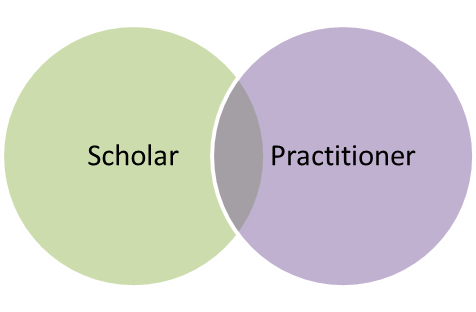

Based on these definitions, the nexus of the research scholar is formally research, whereas the nexus of the scholar-practitioner is practice. That both the research scholar and scholar-practitioner are scholars remains true by definition. However, the central focus and core disciplines of such scholars stand in contrast.
Of course, the research scholar can also engages in practice, just as a scholar-practitioner can conduct research. Moreover, the ambitious scholar might pursue all three domains as a research-scholar-practitioner, though the modern scholar does not generally engage in all three domains at once. Most scholar-practitioners become practicing physicians, attorneys, optometrists, business administrators, psychologists, audiologists, and so forth, and will likely never conduct or publish research during their lifetimes. Conversely, most research scholars choose to decline professional practice as a career pursuit. The idealized career domains for the research scholar, scholar-practitioner, and research-scholar-practitioner are illustrated above.
As preparation for each career path, the candidate scholar will generally pursue a degree program that advances one’s preferred aspirations. For example, the committed research scholar will generally earn a research degree (e.g., PhD, DA, DS) early during a career. Conversely, the dedicated scholar-practitioner will want to earn a professional doctorate (e.g., MD, DO, JD, PsyD, DBA, EdD, DPT, AuD) as preparation for a career in practice. Of course, the educational paths of scholars will vary and exceptions to the above are common. For example, many with research doctorates will become scholar-practitioners during the course of their careers. Likewise, some earning professional doctorates will eventually become full-time research scholars. Exceptions to the above educational paths abound based on individual career choices. However, the aspiring research scholar will generally choose to pursue a research doctorate, while the aspiring scholar-practitioner will usually seek a professional doctorate as preparation for their respective careers.
Concluding, scholars tend to focus their careers on either research, practice, or both, the result of which is to cause the scholar to emerge as either a research scholar, scholar-practitioner, or research-scholar-practitioner. These three career paths tend to guide the aspiring scholar through a preparatory degree program that aligns with the activity focus contemplated along each path. Scholars may later change their career paths based on future career goals, which can result in a quasi-misalignment between one’s doctoral degree and the resulting career path undertaken. Nevertheless, such career shifts appear to be commonplace in modern society as exemplified by the significant number of doctors with professional degrees working as research scholars, as well as the number of doctors with research degrees working in professional practice.
Source: The Free Dictionary
Related Posts
Friday, March 02, 2012
A Better Way of Learning
According to Prof David Friedman:
 Prof David Director Friedman (1945- )
My personal learning experiences align with Prof Friedman's views. Moreover, the latest generation of hand-held computing devices is now affecting how learners prefer to acquire knowledge. The emergence and popularity of "on demand" learning systems is a case in point. I sense that education as we know it is about to change in revolutionary rather than evolutionary ways. For the record, I also sense that the end of "industrial age" education regimes is near. We live in exciting times.
Source: Friedman, D (2012, March 1), A Better Way of Learning, Ideas.
Related Posts
One problem with the usual approach to education at all levels is that it mostly consists of having someone learn something not because he at the moment has any need to know it but because someone else told him to learn it, possibly on the grounds that the knowledge or skill will be useful at some time in the future. It is much easier to get someone to actually learn something if it is of immediate use to him. The best way of learning a computer language, in my view, is not to start by working your way through the manual but to start with a program you want to write. You then have an immediate incentive to learn what you need to write it, and immediate feedback as to whether you have succeeded.Read More

My personal learning experiences align with Prof Friedman's views. Moreover, the latest generation of hand-held computing devices is now affecting how learners prefer to acquire knowledge. The emergence and popularity of "on demand" learning systems is a case in point. I sense that education as we know it is about to change in revolutionary rather than evolutionary ways. For the record, I also sense that the end of "industrial age" education regimes is near. We live in exciting times.
Source: Friedman, D (2012, March 1), A Better Way of Learning, Ideas.
Related Posts
Wednesday, March 07, 2012
Foxconn: Interview Tips
Apple Computer's manufacturing subsidiary, Foxconn, recently published the following helpful interviewing tips on its employment website.

Source: Foxconn

Interviewing TipsLooks like Foxconn has tough interviewing standards for prospective employees. Follow the link below to learn more about career opportunities at FoxConn.
There are three main steps in the interview process: preparation, the interview itself, and follow-up. Foxconn offers these suggestions for handling each step well, and some predictors of interview success or failure.
Preparation
The interview
- Know the exact place and time of the interview, the interviewer's full name and the correct pronunciation, and his or her title.
- Research pertinent facts about the company, such as annual sales revenue, main businesses and products, and locations. A visit to the company's web site or a short web search often provide this information.
- Be ready to discuss how the job might impact your immediate and longer-term career growth.
- Determine 6 to 10 questions you want to ask in the interview. This will help you understand the company better, and it lets the interviewer know you are serious about the job.
- Review the job description, your resume, and cover letter.
- If appropriate, prepare a portfolio of your best work. This is expected in visual arts, writing, or editing. Programmers can use screen captures, diagrams, and short descriptions of applications or other projects they've handled.
- Rehearse answering some questions related to your resume or the career field that you think might be asked.
Follow-up
- Wear proper business attire, be enthusiastic, and greet the interviewer by name, with a solid handshake and a smile.
- Wait until you are offered a chair before sitting. Sit upright, and look alert and interested. Focus your attention on the interviewer at all times.
- Follow the interviewer's leads, but try to get him/her to describe the job and duties early, so you can apply your abilities to the position throughout the interview.
- Don't smoke, even if the interviewer does and offers you a cigarette. Do not chew gum.
- Remember that the interviewer is the mechanism the potential employer uses to determine a "right match."
- Don't forget that the interview also is crucial for you to determine whether the job is right for you. It may turn out not to be a good fit.
- Don't lie, or make unnecessary derogatory remarks about your present or former employers. Limit your comments, if you are asked, to those necessary to adequately convey why you left or are seeking different employment.
- Don't over-answer the questions, especially if the interviewer directs the discussion into politics or other controversial issues.
Predictors of success
- Within one day, be sure to send a thank you letter to the interviewer. If you were interviewed by two people, send two different letters. If you were interviewed by several people, you can send one letter to the main person supervising the hiring process. Thank him/her for the interview and for the other interviews, and ask that your appreciation be extended to the other interviewers.
- All letters should mention the name of the position and interview date.
- Indicate that you are still interested in the position (or not, if that is the case).
- If possible, mention something you learned or discussed in the interview. Let the interviewer know you can be reached by phone or email, and list your email address and phone number.
Predictors of failure
- Ability to communicate clearly
- Demonstrated teamwork, leadership, and problem-solving skills
- Career-related work experience
- Knowledge of the hiring organization
- Ask good questions
- Flexibility and enthusiasm
- People skills
- Professional appearance
- Ambitious and motivated
- Lack of qualifications
- Inability to communicate clearly
- Small evidence of prior achievement
- Lack of knowledge about or interest in the organization
- Unwillingness to relocate
- Appear overbearing, overaggressive, conceited
- Too much emphasis on money and benefits
- Failure to follow-up
Source: Foxconn
Monday, November 21, 2011
Parsing Business Intelligence (BI)
Business intelligence (BI) is now a vital imperative of 21st century enterprise. Yet, a unified view about just what BI is and does for enterprise is only now emerging. Prof Ronald K Klimberg and Prof Virginia Miori (2010) address the challenge by parsing BI as follows:
 Figure 1: Business intelligence/business analytics breakdown
Note that modeling is a central practice in BI. Follow the link below to read the entire article.
Read More
Source: Klimberg, R K & Miori, V (2010, October), Back in Business, INFORMS, 37(5).
Related Posts
Organizations, both corporate and academic, have been rushing to the table with their own BI groups and programs. Though these groups share a common title, BI, they do not share a common understanding of all that BI comprises. The establishment of their functions follows from the specific strengths and expertise within all of these organizations. This shared limitation was not based on a lack of inclusiveness, but merely a lack of cohesive vision. Further, consider that industry’s definition of business intelligence is by and large quite different from academia’s definition. More so, within industries and within academia, these definitions also vary. The definition of BI seems to depend heavily upon your particular perspective or training. What then is business intelligence...?
Despite the appearance of BI in both academia and industry, until now the field has lacked a clear definition. Not all aspects of BI will be exploited in every situation, but it is still important to know what the future holds. Within this structure, BI was broken down into three significant areas: business information intelligence (BII), business statistical intelligence (BSI) and business modeling intelligence (BMI). Specialists exist in all of these areas, but the importance of the intersection and unions of these areas needs to be emphasized. True intelligence results from the melding of all of these technologies and tools....
Figure 1 presents a cohesive vision of business intelligence as a melding of technologies, models, techniques and practices. The three circles of the Venn diagram each represent areas of study and application that had previously been considered quite distinct: 1. information systems and technology, 2. statistics, and 3. OR/MS [Operations Research/Management Science]. It serves to encapsulate the broadening definition of BI. With this new vision, we may now characterize BI from each of three viewpoints as: business information intelligence (BII), business statistical intelligence (BSI) and business modeling intelligence (BMI). Each of the viewpoints has particular business aspects, and academically speaking, courses that are independent of the other viewpoints. Conversely, each viewpoint can work together or utilize techniques/skills from one or possibly two of the other disciplines. For example, data mining, which requires a high level of statistical knowledge as well as the availably of necessary data, may require significant IT skills and/or knowledge. Further, if data mining analysis demands a systematic process of analysis, modeling skills may be required.
Business analytics (BA), within our framework, is classified as a combination of business statistics intelligence (BSI) and business modeling intelligence (BMI): BA = BSI + BMI. BI is the union of the areas of BA, BI and business information intelligence (BII): BI = BII + BA or more specifically BII + (BSI + BMI). As evidenced in the data-mining example, black and white distinctions between disciplines can quickly become gray.

Note that modeling is a central practice in BI. Follow the link below to read the entire article.
Read More
Source: Klimberg, R K & Miori, V (2010, October), Back in Business, INFORMS, 37(5).
Related Posts
Sunday, August 21, 2011
The Future of Tenure at Public Universities
According to Prof James D Miller:
 A Typical Faculty Processional at a College Graduation Ceremony
Source: Miller, J D (2011, August 19), Get Out While You Can, Inside Higher Ed.
Related Posts
Many governors face enormous fiscal shortfalls, forcing them to choose which public employees to anger. Tenured professors, I suspect, have a lot less political clout in most states than do policeman, nurses, prison guards and public school teachers. If online education keeps improving, then I predict that some governor is going to propose firing most of the tenured faculty at his public colleges and replacing the high-priced teachers with online courses. Since Republicans consider academia to be a creature of the far left, many Republican governors would undoubtedly take joy in decimating the traditional higher education market.Embodied knowledge (technology) is beginning to trump embedded knowledge (professors) in higher education -- the future of tenure at public colleges and universities is at best, unclear.

Source: Miller, J D (2011, August 19), Get Out While You Can, Inside Higher Ed.
Related Posts
Tuesday, January 13, 2009
Risk Management in Review
I recently responded to a question in a public forum regarding the limitations of risk management. The specific question posed was, “What limits our ability to effectively manage risk?” This is an interesting question given the financial crisis still underway. My response follows:
Risk management continues to be a misunderstood discipline. The truth is we do have the analytics to understand and manage most kinds of risk (at least to some extent). The more serious problem confronting our society is our apparent inability to apply that knowledge. I'm reminded of the story of a civil war soldier who was listening to one of his officers read from a newspaper. The story goes that the officer quoted from a story by commenting, "...it says here there were fifty percent casualties at the battle of..." The soldier who was listening to the officer's comment responded by asking, "...wow, is that a lot?"
The point is that having the analytics to describe risk, and having the knowledge and training to understand the analytics are two different things. My impression is that many (if not most) business leaders are poorly trained at understanding risk analytics beyond what might be described as layman's terms. What is most needed today is for our business leaders to become more knowledgeable of how to understand and use risk analytics in an effective and meaningful manner. The days of making guesses based on institutions are long gone, especially when those decisions can result in losses of billions of dollars, as well as suffering amongst the ranks of employees and other stakeholders who are ultimately victimized by those decisions.
My advice to business leaders at all levels is to make risk analysis a centerpiece of their training in graduate school. If you puzzle over terms such as variance, standard deviation, stochastic, optimization, and so forth, then it may be time to schedule some training in these skills as part of your lifetime learning plan.
Risk management continues to be a misunderstood discipline. The truth is we do have the analytics to understand and manage most kinds of risk (at least to some extent). The more serious problem confronting our society is our apparent inability to apply that knowledge. I'm reminded of the story of a civil war soldier who was listening to one of his officers read from a newspaper. The story goes that the officer quoted from a story by commenting, "...it says here there were fifty percent casualties at the battle of..." The soldier who was listening to the officer's comment responded by asking, "...wow, is that a lot?"
The point is that having the analytics to describe risk, and having the knowledge and training to understand the analytics are two different things. My impression is that many (if not most) business leaders are poorly trained at understanding risk analytics beyond what might be described as layman's terms. What is most needed today is for our business leaders to become more knowledgeable of how to understand and use risk analytics in an effective and meaningful manner. The days of making guesses based on institutions are long gone, especially when those decisions can result in losses of billions of dollars, as well as suffering amongst the ranks of employees and other stakeholders who are ultimately victimized by those decisions.
My advice to business leaders at all levels is to make risk analysis a centerpiece of their training in graduate school. If you puzzle over terms such as variance, standard deviation, stochastic, optimization, and so forth, then it may be time to schedule some training in these skills as part of your lifetime learning plan.
Friday, April 16, 2010
Business Intelligence Requires Thinkers
The emerging turf war between information technology (IT) departments and business intelligence (BI) analysts is reaching a crescendo as the vanguards of these interest groups meet in the void between. Clearly, the topological space between technologists and analysts has become blurred as the commoditization of knowledge assets into technology encroaches into the vital knowledge domains of subject matter experts and professionals. At stake is the future of vast human and structural capital formations, and while IT departments continue to herald BI as a technology function, the voices and concerns of business analysts are starting to be heard in the executive suite, especially as BI becomes a form of competitive advantage between firms in the new millennium. Arthur Ritchie of SAND Technology concludes that analysts will require greater access to controlled data resources in order for BI to fulfill its potential:
 Source: Arthur’s Blog
In my view, unless talented analysts are given unfettered access to whatever corporate data they require and the ability to analyze it as they see fit in the context of the many external data sources that are available, we will continue to find ourselves unprepared to deal with the unexpected. Implemented correctly, corporate Business Intelligence (BI) systems can support an organization’s best analysts as they challenge traditional business dogmas and develop a practicable way forward based on the facts, as recorded in detailed corporate data. To achieve this, IT departments need to stop acting as “data jailors” who strictly control which data will be accessible, in what form, and start empowering creative thinkers to realize their maximum potential, be it in marketing, manufacturing, distribution or some other field. In order to do this, however, IT departments need to start acting more like a power utility service: enabling “decision support” (to revive an older term for BI) by providing corporate information or raw data as required, in the right amounts at the right time, while also serving as “consultants” who help end users access the data they require, when and how they need it.Ritchie’s central argument is that BI systems must work to support BI production as defined by analysts’ requirements. The fact is that BI is not only a production process that requires systems, but also a thinking process that requires both ad hoc and post hoc analysis and testing by subject matter experts. The future of BI requires restoration of the decision support function. Moreover, analysts rather than technologists must assume greater responsibility and leadership over the overall BI effort.

Tuesday, February 14, 2012
Universities to Become Coffee Shops
According to Stephen T Gordon of the Boston Globe, our nation's universities will soon become coffeeshops.
 Saint's Cafe, State College, Pennsylvania
Follow the link below to learn more about MIT's new online learning initiative.
MITx
Also, be sure to visit Saint's Cafe the next time you are in State College, Pennsylvania (home of "Penn State"). You might just see me there blogging away...
Saint's Cafe
Source: Gordon, S T (2012, February 12), In the Future, Everything Will Be a Coffee Shop, Boston Globe.
Related Posts
College is becoming untenably expensive in the United States. Having a college degree means that you are much more likely to find good employment — but tuition and other costs have far outpaced inflation for decades. As the debt required to get an education rises, students and their families face a question: What’s the advantage of a good job if the salary difference is lost to student debt?Read More
Online universities are starting to change this equation. MIT, a pioneer in making course materials available online for free, announced in December that it will begin to offer a credential for completion of online courses through a new program called MITx. The program is intended to offer MIT’s teaching materials to a wide range of students. Though it will carry some costs for students, the university’s press office has stated, “The aim is to make credentialing highly affordable.”
Now, imagine a personnel manager at a mid-sized corporation who’s looking for an employee with some particular knowledge. There are two candidates: one with an appropriate college degree from the local state school, a second with relevant MITx certificates. Let’s say all other things between the candidates are equal. Which should the manager choose?
Given the caliber of professor [sic] at MIT, the online student may have learned just as much. The candidate who went to college probably enjoyed his experience more, but the potential employer is unlikely to care about that. Finally, there’s the financial reality: To some extent, the student debt of the job candidate dictates his salary requirements. If the MITx candidate has the knowledge required and far less student debt, he probably can be hired more cheaply. Ultimately, the cheaper option will win.
Follow the link below to learn more about MIT's new online learning initiative.
MITx
Also, be sure to visit Saint's Cafe the next time you are in State College, Pennsylvania (home of "Penn State"). You might just see me there blogging away...
Saint's Cafe
Source: Gordon, S T (2012, February 12), In the Future, Everything Will Be a Coffee Shop, Boston Globe.
Related Posts
Friday, January 22, 2010
Business Analytics: Questions for Enterprise
Firms today are increasingly seeking competitive advantage through advances in business analytics and decision support systems. According to a white paper published by nGenera (2008) in collaboration with Prof Thomas Davenport: 
The next wave of business reengineering is being powered by business analytics, and the potential performance breakthroughs are just as large as they were 15 or so years ago. Many of these breakthroughs will come through the ability to integrate the demand side of the house with the supply side of the house as never before. Even information-rich industries have tended to concentrate on one side or the other. With the power of business analytics, corporations can make and manage the demand-supply connections – a big step closer to the goal of optimizing the performance of the corporation as a whole.

Here are six topical questions (with supporting questions) posed by nGenera for companies seeking to compete analytically:
Reference: Business Analytics: Six Questions To Ask About Information And Competition (2008), Austin, TX: nGenera Corp.1. Where should we leverage business analytics?
- What is our distinctive capability? On what basis do we choose to compete? And how clear and definitive are we about that choice?
- What performance levels or innovations in this area would blow away the competition?
- What information, knowledge, and insight would it take to perform that way? What are the biggest unanswered questions and biggest opportunities?
- How would we act upon that information, knowledge, and insights.
2. Why now?
- What are our direct competitors doing or attempting with business analytics? Is anyone in our industry jumping ahead in terms of analytical capability?
- How are analytics changing our competitive landscape? Are we at risk from non-traditional competitors who may use analytics to encroach on our markets?
- What emerging technologies of information integration and analysis should we be exploring more aggressively?
- How fast can we launch a serious business analytics initiative? What’s holding us back?
3. What's the payoff?
- What are our specific performance goals in the area where we choose to compete?
- How well do we measure them? How might better measurement and analysis of today’s performance reveal tomorrow’s opportunities?
- How well aligned are the organization, its management, and its stakeholders with these performance goals?
- What’s our highest ambition? What would it mean in terms of revenue, profit, and market share if we were really to change the basis of competition?
4. What information and technology do we need?
- Is the information we need at hand? Is the data that support our distinctive capability in one repository, with common definitions of key data elements?
- Is this data integrated enough not only to be accessible, but also to be manipulated with analytical tools?
- How completely and accurately does the information measure and represent our distinctive business capability and basis of competition? Is it up-to-date? What are the most glaring gaps and shortfalls?
- Do we have the technologies in place to support business analytics in this area? Or is technology fragmentation holding us back?
5. What kinds of people do we need?
- Do we have a critical mass of analytical professionals on staff? Are we prepared to hire them? Do we need to “rent” this talent in the short term to fill gaps?
- Who can manage analytical professionals? Who has the necessary experience, credibility, and “bridging” skills?
- Will we be ready to train employees to apply the analytical results and operate differently?
- Is the organization at large oriented toward analytical decision-making, or is it wedded to yesterday’s procedures and rules of thumb? How quickly can the organization come up to speed analytically?
6. What roles must senior executives play?
- Are we committed to competing on analytics, starting at the top of the organization? What are the CEO and executive team doing to demonstrate that commitment?
- Is the leader of the analytical function prepared to act upon the results of the analyses? Are the roles and decision rights of other stakeholders, including the CFO and CIO, clear – especially when their roles are novel or overlap?
- Do we have a project leader who can span the worlds of strategy, process performance, and analytics?
Tuesday, October 16, 2007
My Mission
Dr Stephen Covey makes the point that "the key to the ability to change is a changeless sense of who you are, what you are about, and what you value." Hence, "who am I, what am I all about, and what do I value?" These are all good questions.
For years now, I've tried to guide my actions and decisions based upon an integrated and comprehensive understanding of my beliefs, values, knowledge, experiences, motives, and drives -- what some might call a "mission statement." Here is my mission as it appears in a framed version that stands on my desk:
• I am MY OWN MAN. I choose how to LIVE my life. I take RISKS and accept RESPONSIBILITY. I have a right to be HAPPY.
• I am a LEARNER. I seek to UNDERSTAND life and the universe. EXISTENCE is instructive.
• I make INTEGRITY a guiding principle in my affairs. I am impeccable to my WORD and strive for ACHIEVEMENT. I avoid taking things PERSONALLY, and resist making ASSUMPTIONS about people.
• I respect POWER and understand how KNOWLEDGE, WEALTH, and VIOLENCE affect me. I practice INNOVATION, IMPROVISATION, and ADAPTABILITY.
• I match PROFIT to PRINCIPLE in the conduct of business. I promote ENTERPRISE amongst STAKEHOLDERS. I foster and nurture COLLEGIALITY within my domains.
• I am FRUGAL. I seek to get the most VALUE from my time and the things I have the use of. I invest for my ESTATE and use it to pursue a LIFESTYLE of fitness and growth.
• I practice CHIVALRY. I have COMPASSION for the innocent. I MENTOR deserving talent along the way and give the CREDIT to those who deserve it.
• I live in the LIGHT and fear the darkness. I understand the difference between REALITY and delusion. I believe TRUTH prevails over lies.
Download
For years now, I've tried to guide my actions and decisions based upon an integrated and comprehensive understanding of my beliefs, values, knowledge, experiences, motives, and drives -- what some might call a "mission statement." Here is my mission as it appears in a framed version that stands on my desk:
• I am MY OWN MAN. I choose how to LIVE my life. I take RISKS and accept RESPONSIBILITY. I have a right to be HAPPY.
• I am a LEARNER. I seek to UNDERSTAND life and the universe. EXISTENCE is instructive.
• I make INTEGRITY a guiding principle in my affairs. I am impeccable to my WORD and strive for ACHIEVEMENT. I avoid taking things PERSONALLY, and resist making ASSUMPTIONS about people.
• I respect POWER and understand how KNOWLEDGE, WEALTH, and VIOLENCE affect me. I practice INNOVATION, IMPROVISATION, and ADAPTABILITY.
• I match PROFIT to PRINCIPLE in the conduct of business. I promote ENTERPRISE amongst STAKEHOLDERS. I foster and nurture COLLEGIALITY within my domains.
• I am FRUGAL. I seek to get the most VALUE from my time and the things I have the use of. I invest for my ESTATE and use it to pursue a LIFESTYLE of fitness and growth.
• I practice CHIVALRY. I have COMPASSION for the innocent. I MENTOR deserving talent along the way and give the CREDIT to those who deserve it.
• I live in the LIGHT and fear the darkness. I understand the difference between REALITY and delusion. I believe TRUTH prevails over lies.
Saturday, December 22, 2012
The National Math and Science Initiative
As reported by the National Math and Science Initiative:

I applaud this 21st century education program. Our nation needs more professionals with advanced skills in science, technology, engineering, and mathematics (STEM) has never been greater. To meet this challenge, the US must expand its cadre of talented mathematics and science teachers in the public school system. Again, I endorse the National Math and Science Initiative.
Related Posts
The US is failing to produce and retain sufficient numbers of qualified math and science teachers to keep America internationally competitive. It is estimated that the US will need 280,000 more math and science teachers by 2015. Talented math and science teachers with strong content knowledge are urgently needed to help students reach their potential.Learn More
I applaud this 21st century education program. Our nation needs more professionals with advanced skills in science, technology, engineering, and mathematics (STEM) has never been greater. To meet this challenge, the US must expand its cadre of talented mathematics and science teachers in the public school system. Again, I endorse the National Math and Science Initiative.
Related Posts
Saturday, February 11, 2012
Mathematics, Problem-Solving, and Critical Thinking
The following is extracted from a speech presented by Grace Fu to winners of the Singapore Mathematical Society's Annual Prize Presentation Ceremony in 2008:
 Grace Fu Hai Yien (Chinese: 傅海燕; pinyin: Fù Hǎiyiàn)
Source: Fu, G (2008), Speech at the Singapore Mathematical Society Annual Prize Presentation Ceremony.
Related Posts:
Pascal on Analysis
Conceptual Mathematics in Singapore
Mathematics will imbue you with problem-solving skills such as the ability to understand a problem, identify the relevant information, look for relationships and patterns, make your own conjectures and apply mathematical knowledge and tools to solve or prove them. Mathematics, thus, provides good opportunities for the training of the mind to think critically and adapt to new situations, something that will be valuable to your future careers.The words above are instructive for anyone seeking to join the ranks of analytics professionals worldwide. The ability to solve complex problems through critical thinking and reasoning is essential in today's analytics-based economy. Singapore is recognized around the world as a leader in the conceptual mathematics movement.

Source: Fu, G (2008), Speech at the Singapore Mathematical Society Annual Prize Presentation Ceremony.
Related Posts:
Pascal on Analysis
Conceptual Mathematics in Singapore
Wednesday, April 13, 2011
Ways to Prepare for Economic Depression
Here are some ways that ordinary people can prepare themselves and their families for economic depression:
 I weep for those suffering economic hardship in America today, even if what we are experiencing is only a "recession"...
Related Posts
- Convert knowledge and experiences into basic skills.
- Eliminate indebtedness.
- Stockpile food, water, and medications.
- Avoid marriage or divorce until prosperity returns.
- Avoid adding children until prosperity returns.
- Start a garden.
- Use public transportation.
- Expand your circle of friends.

Related Posts
Subscribe to:
Posts (Atom)